
PRACTICE AREAS
PRODUCTS LIABILITYS - POST CRASH FIRES
The focus of fuel system cases revolves around post-collision fuel-fed fires. In these cases, occupants are unnecessarily burned and killed from the fuel system fire, as compared to the forces of the crash. Vehicle fuel system designs raise three basic defect claims. |
A. Tank Location
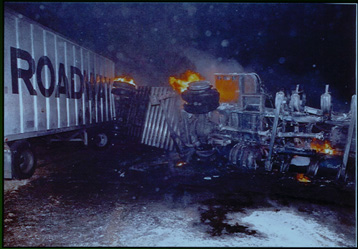
These claims concern the manufacturer’s choice to locate the fuel tank in an unsafe position where it is expected to be compromised by a crash. Examples include the Ford Pinto and the Crown Victoria, GM’s CK pickups, and most heavy truck fuel systems. The following film clip shot by government investigators is a graphic display of what can happen when an exposed fuel tank on a semi scrapes a concrete wall. Testers took care to fill the tank with a non-flammable solvent instead of fuel so there would be no fire.
“This is a very common type of impact for a heavy truck – it simulates a truck hitting a freeway guardrail,” says Lee Brown. “It shows how violently the tank is knocked off.”
B. SHIELDING
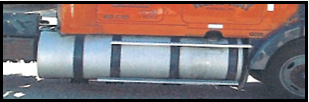
Fuel tanks are normally made out of a very lightweight aluminum, steel or plastic. Accordingly, the tanks can be easily compromised if they are struck by anything in the crash. As a result, some manufacturers have appropriately guarded or shielded the tanks with steel, plastic and HDPE type materials to enhance their crashworthiness. Although car manufacturers have typically shielded their passenger car and light truck tanks, heavy truck manufacturers have refused to do so.
C. FUEL LINES
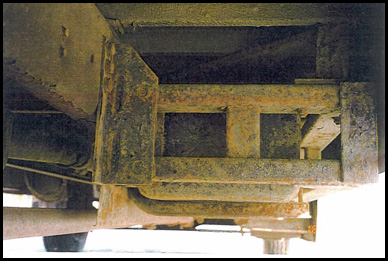
When a vehicle catches fire after a crash, it is often assumed that there was a leak in the fuel line. While leaks are a major problem, an equally important defect is the siphoning of gasoline from the tank. Siphoning is the flow of gasoline through a discharge point caused by the pressure between the fuel tank and the opening. Depending on the location of the break in the fuel line (below or above the fluid level in the tank), siphoning can result from either gravity or pressure in the fuel system.
Manufacturers have known how to repair the siphoning defect for many years – and at a minimal cost. GM and Ford documents from the early 1970s prove that the companies knew about the danger, knew that various check or shutoff valves would solve the problem, yet declined to implement the solution.
Manufacturers have known since 1960 that there must be check valves or other safety devices incorporated in the fuel filler necks to prevent the escape of fuel during a collision. Nevertheless, management decisions that stressed profit over safety has resulting in fuel system failures frequently involving the fuel line and/or check valve failures.
The United States Department of Transportation (USDOT) and the National Highway Safety Bureau (NHSB) issued a report in 1967 concerning the performance standards of fuel tank protection. The report found that it was common for fuel to spill out of the fuel filler neck in the event of a rollover accident or other type of collision. The report concluded that the check valves located in the fuel filler neck would eliminate fuel spillage during rollover collisions. The report also noted that these check valve assemblies were available to be purchased for stock cars, which were being used in NASCAR-sponsored races:
“Information received from Accident Data Reports indicate that the rollover type of accident accounts for the highest coincidence of fatal burn injuries. In a rollover accident, fuel is often spilled from a virtual intact system. Separation of filler pipe from the body shell or from the tank opening is a large exit for fuel. Also, the vent pipes of the fuel tank can spill during and following an overturn accident.
Check valves working with the filler pipe and vent pipe openings of a fuel tank would eliminate spills during rollover or upset. These check valves might be gravity operated, spring loaded, or operated by a vacuum from the engine. There is at least one source of check valve assembly which may be purchased for installation and stock cards used in NASCAR-sponsored races.”
The concept of a check valve is nearly as old as automobiles themselves. Yet manufacturers have only recently incorporated these check valve designs and so-called frangible valves that prevent accidental loss of fuel into vehicle designs.
For more information: Contact Us