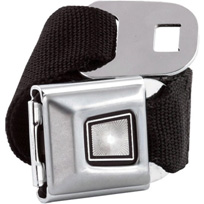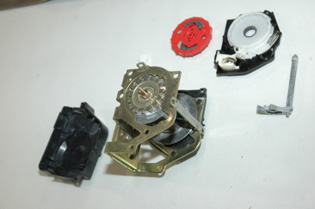

Statistics tell us that in the modern crash environment a very large percentage of occupants are belted. Various studies put the number over 80%. Naturally, this begs the question, why are such a large percentage of rollover victims still being injured? Injuries to belted occupants arise mostly from three types of defects.
Three Types of Defects
A. Unlatching
Seat belt buckles have been proven to inertially unlatch. Automobile manufacturers have been aware since May of 1966 of the potential for the center button seat belt to come open or release during impact. Nevertheless, the automobile manufacturers have claimed that such a release does not happen in the real world accidents.
The mechanism which causes release is the effect of inertia acceleration forces on the buckle housing and spring, causing the pawl to depress and release the latch.
A 1978 study by NHTSA shows that out of 225 vehicles tested, 50 would unlatch when the vehicle was subjected to an impact on the back of a buckle.
But in 1978, NHTSA was not concerned with the issue because at the time there was not a large percentage of drivers and passengers wearing seat belts. Accordingly, NHTSA concluded that based upon the laboratory test, there was not sufficient evidence of inertia unlatching in the real world to warrant action.
However, twenty years later, many states have enacted seat belt laws which require drivers and passengers to buckle up. In 1997, GM simulated a side-impact crash, generally the most dangerous accident to be involved in. The camera captures the seat belt releasing under pressure.
The phenomena of inertial unlatching in side-release in the RCF-67 buckles has been the subject of intense litigation recently. The buckle's RCF designation stands for the initials of Robert C. Fisher, the buckle's original designer at General Motors Company, while "67" refers to the calendar year 1967 when the buckle was originally developed. The RCF-67 buckle is a side-release buckle design which utilizes a spring-loaded pawl (connected directly to a side-mounted push button) which slips into an aperture in a flap latch plate against which the tongue (to which the shoulder restraint and lap belts typically attach) is slid into the buckle.
As the tongue is inserted into the buckle, sliding perpendicularly to and in the same plane as the latch plate, the spring-loaded pawl is pushed aside until the pawl "clicks" into the tongue aperture. This theoretically is intended to lock the pawl into the tongue aperture inside the buckle and retain it there under pressure from the spring until the user again depresses the button pushing the pawl out of the tongue aperture and allowing the tongue to be withdrawn from the buckle.
The RCF buckle has two principal defects. First, if the tongue is not inserted completely into the buckle to permit the spring-loaded pawl fully to clip into the aperture, the buckle's locking mechanism does not come into operation, allowing the tongue to be pulled out of the buckle during a moderate deceleration, significant occupant movement, and/or the force of the spring-loaded retractor of the belt restraint. This is a "false-latch," also called a "partial engagement" scenario. The second problem with the RCF buckle design is that a sudden and significant force delivered perpendicular to and opposite the plane of the side release button can essentially cause the button and linked pawl to become "depressed" relative to the plane of the latch plate, paramount to the user pushing the button and causing the buckle to unlatch inadvertently.
The design of the RCF-67 buckle permitting false and inertia unlatching is fundamentally the same as that of the Tokai Rika B-020, ASEC 476215, and Gateway 900 seat belt buckles. While most of the automakers have transitioned into the so-called "European style" end-release buckles, Ford Motor Company, the leading domestic maker, continued to deploy the RCF buckles with a substantial percentage of its production vehicles, especially in SUVs and light trucks, largely for cost-reduction purposes. At present, there are millions of vehicles at large equipped with the RCF buckles operating daily through the nation at constant risk of sudden false and inertia unlatching of those buckles, with their inherently catastrophic injury potential fully known by the manufacturers.
"Safer belt designs predated the RCF-67 and were used by other manufacturers at the same cost", says Lee Brown, "but two of the world's largest manufacturers, Ford and GM, heavily promoted Fisher's buckle. Millions of vehicles were never recalled because of the sheer cost of recalling versus fighting a few lawsuits by consumers who realized it was the belt that caused the injury and not the crash." What many Americans may not realize is that there are the limitations the government faces when confronting the automobile industry about a recall. Federal guidelines state that if the cost of a recall is financially burdensome, then the death and injury that can happen to a percentage of people, although wrong, does not justify a recall. Brown points out that leaves injured victims with only one option: To sue manufacturers in court.
B. Retractor Failures
Aside from the seat belt buckles coming unlatched in a crash, many seat belt retractors fail to adequately perform in crashes because the retractors fail to lock or stay locked during the accidents. Examples include the following:
1. Pendulum-Type Retractors
Centrifugal forces acting on the pendulum in the retractors cause the retractor to lock. Normally this pendulum hangs straight down and the belts move in and out freely. In an accident, the inertia forces of the accident cause the pendulum to move and contact the lock bar, which locks a gear on the retractor that is supposed to prevent the movement of the seat belt. However, during rollovers, the centrifugal force exerted on the retractor due to spinning about the longitudinal axis can be greater than the gravity force and thus cause the pendulum and locking bar to pull away from the gear and allow the seat belt to unravel. A solution to this problem would be to add the inertia locking reel to the belt system or a web-grabbing device and/or pretensioner.
2. Skip-Lock Other retractors rely on plastic wheels or faulty mechanisms that lock and then allow the locking pawl to "skip" over several of the cogs in the gear of the retractor. Evidence of skip-lock would be revealed on the teeth or gears of the retractor.
3. Spool-Out
Other retractors, particularly those without web grabbers, are susceptible to spool-out. In simple terms, spool-out normally occurs where there's too much webbing on the retractor that allows an unnecessary amount of seat belt excursion after the seat belt retractor is locked. The slack created by a spool-out allows unnecessary movement of the occupant. As a result, the occupant's head can strike the roof or pillars in an unsafe manner. |